
CMUH and Partners Unveil Breakthrough Targeted Exosome Platform for Non-Invasive Spinal Cord Injury Repair

Developed by China Medical University Hospital, Ever Supreme International Biotechnology Co., Ltd. and SHINE OUT BIO TECHNOLOGY CO., LTD., the platform facilitates intravenous, lesion-targeted delivery of BDNF mRNA and improved motor coordination in preclinical models.
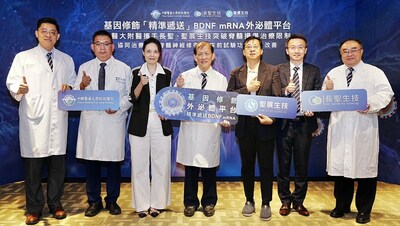
TAICHUNG, April 24, 2026 /PRNewswire/ — China Medical University Hospital (CMUH), in collaboration with Ever Supreme International Biotechnology Co., Ltd. and SHINE OUT BIO TECHNOLOGY CO., LTD., has unveiled a targeted gene-engineered exosome platform for acute spinal cord injury (SCI) that enables intravenous, lesion-targeted delivery of brain-derived neurotrophic factor (BDNF) mRNA. In preclinical models, the platform demonstrated significant improvement in motor coordination. The findings were published in Journal of Nanobiotechnology, a peer-reviewed journal.
Spinal cord injury remains one of the most challenging conditions in neurological medicine. According to the World Health Organization, the global incidence of spinal cord injury is estimated at 40 to 80 cases per million people each year, with many patients facing permanent disability and long-term rehabilitation. Existing treatment approaches often involve invasive procedures, while recovery outcomes remain suboptimal.
CMUH said the newly developed mBDNF@αITG EV gene-engineered exosome platform is designed to address two major barriers in SCI treatment: the need for invasive local administration and the limited targeting ability of conventional exosomes. By using intravenous delivery, the platform is intended to guide therapeutic cargo to injured spinal cord tissue in a non-invasive manner.
Addressing Key Clinical Limitations in Spinal Cord Injury Treatment
Spinal cord injury often results in severe functional loss and permanent disability. Superintendent Der-Yang Cho, a neurosurgeon at CMUH, said current cell-based therapies typically require direct injection into the injury site, which may increase the risk of secondary trauma and infection in already damaged tissue and can limit broader clinical use due to procedural complexity.
At the same time, conventional unmodified exosomes generally lack lesion-targeting specificity. Once introduced into systemic circulation, they may be rapidly cleared and face difficulty crossing the blood-spinal cord barrier, reducing therapeutic concentration at the injury site.
To overcome these limitations, the research team applied nanoengineering and genetic engineering strategies to create an exosome-based delivery system designed to selectively homing to injured spinal cord tissue after intravenous administration. The approach supports a more precise and less invasive regenerative treatment strategy for neural repair.
Dual-Action Neural Repair: Modulating Inflammation and Oxidative Stress
According to Ming-Chuan Li, Deputy General Manager of SHINE OUT BIO TECHNOLOGY CO., LTD., cells in the injured spinal cord microenvironment upregulates molecular marker, integrin αvβ8. The team engineered exosomes to display a corresponding recognition ligand on their surface, creating the αITG EV targeting carrier. The exosomes were also loaded with BDNF mRNA, a therapeutic payload associated with neural repair.
Once delivered to the lesion site, the BDNF mRNA@αITG EV platform was found to exert both immunomodulatory and metabolic effects. The researchers reported that the platform helped shift local microglia from a pro-inflammatory state to a reparative phenotype and significantly reduced inflammatory cytokines including TNF-α and IL-1β.
Ming-You Shie, Deputy Director of the Xenotransplantation Translational Research Center at CMUH, said the delivered BDNF mRNA enhanced antioxidant protein expression and stabilized mitochondrial dynamics, helping ameliorate secondary oxidative damage.
“By simultaneously modulating neuroinflammation and inhibiting neuronal ferroptosis, we observed marked recovery in motor coordination in rat models,” Shie said. “Our goal is to transform SCI treatment from supportive care to active neural regeneration.”
Commercialization and Regulatory Strategy: Advancing a Translational Pathway for Regenerative Medicine
The publication in Journal of Nanobiotechnology provides peer-reviewed support for the platform’s preclinical findings. CMUH and its partners said the results point to the potential of a non-invasive, targeted treatment strategy for spinal cord injury and other central nervous system disorders.
In January 2026, Ever Supreme International Biotechnology Co., Ltd. integrated SHINE OUT BIO TECHNOLOGY CO., LTD. through a share-swap transaction to strengthen its capabilities in exosome and cell-based therapy development and expand its presence in central nervous system applications. The integration creates a powerful synergy between CMUH’s clinical expertise and the partners’ manufacturing capabilities.
Li said Taiwan’s regenerative medicine framework may help accelerate the clinical development and regulatory review of therapies targeting severe disability and life-threatening conditions. As the platform advances through future clinical development, the team plans to work within the applicable regulatory framework to explore opportunities for earlier patient access, subject to safety, efficacy and regulatory requirements.
“Time is the most precious resource for patients with spinal cord injuries,” Li said. “We hope continued development of this platform will expand future treatment options for patients.”
The collaboration aims to advance a safer and more precise therapeutic approach for spinal cord injury and support the broader development of neuroregenerative medicine.
*Note: Leading International Journal in Nanobiotechnology
https://link.springer.com/article/10.1186/s12951-026-04222-7
 View original content to download multimedia:https://www.prnewswire.com/news-releases/cmuh-and-partners-unveil-breakthrough-targeted-exosome-platform-for-non-invasive-spinal-cord-injury-repair-302752652.html
SOURCE China Medical University Hospital
 Disclaimer: The above press release comes to you under an arrangement with PR Newswire. USA Newshour takes no editorial responsibility for the same.

