SpaceX rocket Falcon 9 debris creates light show in Pacific Northwest sky

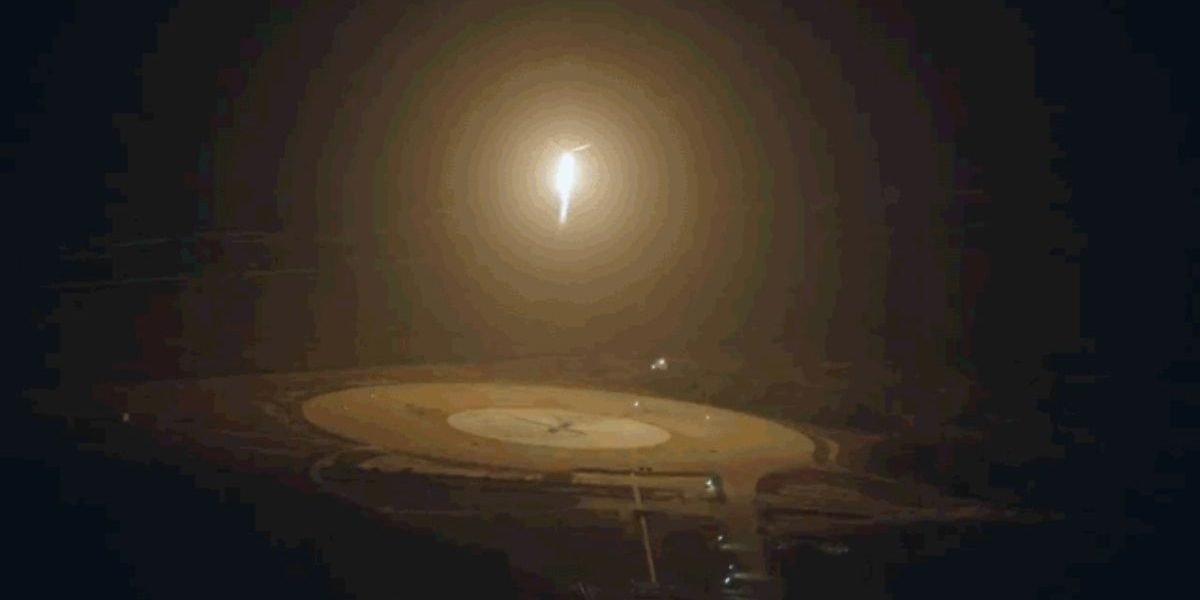
Oregon and Washington were treated to an unexpected show last night: a meteor shower streaking lazily across the night’s sky. Though what looked like a meteor was actually remains of SpaceX’s Falcon 9 rocket burning up as it travelled through the atmosphere.
Although SpaceX has not yet claimed responsibility for the spectacle, meteorologists and astronomers ID’ed the lights in the sky as harmless rocket debris.
The Falcon 9, which is a partially reusable two-stage rocket found its second stage debris lighting up the atmosphere. The first stage houses nine of SpaceX’s Merlin engines does the initial heavy lifting of getting the rocket off the ground, while the second stage, with just a single Merlin engine, guides it into a parking orbit.
The first stage can be steered back down to Earth, and it’s this section of the rocket you’ve probably seen safely landing on SpaceX’s drone ships. The second stage is usually left to decay in orbit or directed to burn up in the planet’s atmosphere.
The launch of this Falcon 9 took place on March 4th, putting another batch of SpaceX’s Starlink satellites into orbit, with the first stage of the rocket safely landing back on Earth.
Jonathan McDowell, an astronomer at the Center for Astrophysics, tweeted a thread about the event, noting that this sort of debris re-entry is not uncommon.
McDowell notes that the debris breaks up high in the atmosphere, around 40 miles or 60 kilometers above the ground that’s well above the cruising altitude of commercial flights. But the combination of headwinds in the Earth’s upper atmosphere and the speed of travel make it difficult to predict exactly when and where re-entry will take place.
The National Weather Service (NWS) of Seattle also identified the bright lights as debris from a Falcon 9 second stage. The NWS noted that the speed of such debris re-entry is much slower than that of meteor showers, which move at speeds greater than 45,000 mph.
Such re-entries are generally safe, with all rocket components and material burning up in the atmosphere. As Seattle’s NWS tweeted: “There are NO expected impacts on the ground in our region at this time.”